Monday, March 26, 2018

RECENT WORK (Group Show). Jedlitschka Gallery, Zürich.

March 22 - May 12 2018


Chris Dennis.

Pat Noser.
Rik Beemsterboer.
Alex Bär.
Margo.
Bogomir  Krajnz.

Bogomir  Krajnz (detail).
Marc Moser.
JJ White (L). Pep Camps (R).
Pep Camps.
Pep Camps.
Mario Dalpra.

Mario Dalpra.
Thomas Santhori.
Pep Camps. Bruno Müller Meyer.
Chris Dennis.


Bogomir  Krajnz.

Tobia Bucher (L) David Segeta (R).

Chris Dennis. A Little Less. 40 x 40cm. 2018


Thursday, March 15, 2018

Albert Oehlen and Julian Schnabel. Galerie Max Hetzler. Berlin.

Albert Oehlen

Julian Schnabel
Julian Schnabel (detail)
Albert Oehlen
Albert Oehlen (detail)
Julian Schnabel, Albert Oehlen
Albert Oehlen
Albert Oehlen (detail)
Albert Oehlen
Albert Oehlen
Albert Oehlen (detail)
Julian Schnabel
Julian Schnabel (detail)
Julian Schnabel
Julian Schnabel
Albert Oehlen


Julian Schnabel

Albert Oehlen (detail)
 
Berlin: Goethestraße 2/3, 14 March – 14 April 2018

Press Release: Galerie Max Hetzler is pleased to announce an exhibition with new paintings by Albert Oehlen and Julian Schnabel at Goethestraße 2/3.
Both known as major protagonists of a constant exploration of the process of painting, Albert Oehlen and Julian Schnabel deeply influenced and defined the art field since the 1980s, provoking a departure from painting as conventionally understood. For the first time, Galerie Max Hetzler presents a duo exhibition of these artist companions and friends, focussing on their recent bodies of works.
With a chromatic spectrum consisting mainly of subtle variations of grey, including highlights of green, yellow and pink, the canvas’ surface of Albert Oehlen’s latest paintings witnesses a complex and intriguing process of overpainting. The elaborated interplay of broadly applied brushstrokes and overlapping layers of paint build a dynamic impression of colour and movement. Shapes and compositional patterns are generated and often immediately dissolved during the work process, creating an intense atmosphere of a painterly landscape that emerges out of the captivating pictorial depth.
Alongside these paintings, several works on paper allow an inside into this particular part of Oehlen's multifaceted oeuvre. A recurring motif in the artist's work, the tree appears as the central topic of this group of works. It serves as a simple element which gives the artist the liberties to examine form and line making. Black shapes, ink and pencil lines, mere silhouettes of a leafless tree, structure the paper. Even though the affinity and interaction is clearly visible, Oehlen's works on paper distinguish themselves from his paintings, marking an independent category and a kind of distillation of his painterly work.
The exhibited series of new works by Julian Schnabel consists of six paintings made from material that was used to cover an outdoor market in Mexico. A vibrant pink dominates the background, while fir green and dark purple brushstrokes delineate different compositional elements on the surface. The works are characterised by a formal unity as each of them is populated by variations of lines and organic shapes. The distinctively individual, yet interweaving forms evoke landscapes, flowers and figures. While bearing a strong representative potential, each painting still triggers the viewer’s imagination. As a whole, the series constitutes a gestural and poetic field that is reinforced by the sheer physicality of the found fabric.
Schnabel considers found materials, their physical characteristics as well as history essential components of his painterly compositions. In the present series, the linen pieces are marked by stains, stitches, holes and ripples that testify to their previous use as covers for fruit and vegetable stands in the market of Zihuatanejo.
Completing this duo exhibition, two works depict portraits of Albert Oehlen and Julian Schnabel, painted by the respective other. Schnabel realised his portrait of Oehlen in 1997 as part of his series of resin portraits, while Oehlen's portrait of Schnabel was created just recently in 2018. Each painting clearly bears the painterly gestures of its particular period in the artist's career while emphasising the special relationship the two painters share.
Albert Oehlen (*1954, Krefeld) lives and works in Switzerland. Since 1981, he has been exhibiting regularly at Galerie Max Hetzler. Oehlen‘s work has been shown in numerous solo exhibitions in international institutions, such as Museo Nacional de Bellas Artes, Havana (2017); Cleveland Museum of Art and Guggenheim, Bilbao (both 2016); New Museum, New York and Kunsthalle Zürich, Zurich (both 2015); Museum Wiesbaden (2014); mumok, Vienna (2013); Kunstmuseum Bonn (2012); Carré d‘Art de Nîmes (2011); Musée d‘Art Moderne de la Ville de Paris (2009); Whitechapel Gallery, London (2006); MOCA, Miami; Kunsthalle Nürnberg, Nuremberg (both 2005); Musée Cantonal Des Beaux Arts, Lausanne; Domus Artium 2002, Salamanca and Secession, Vienna (all 2004) among others. A major survey is scheduled in April 2018 at Palazzo Grassi in Venice.
Julian Schnabel (*1951, Brooklyn) lives and works in New York, Montauk and San Sebastian. His work has been exhibited in numerous solo and group shows at international institutions, such as the Royal Academy, London; Whitney Museum of American Art, New York (both 2017); Aspen Art Museum (2016); Museu de Arte de São Paulo Assis Chateaubriand (2014); The Metropolitan Museum of Art, New York; Martin-Gropius-Bau, Berlin; Kunsthalle Bern (all 2012); Museum für Moderne Kunst, Frankfurt/Main (2011); MOCA Grand Avenue, Los Angeles (2009); Contemporary Art Museum Kiasma, Helsinki; Tate Modern, London (both 2008); Beijing World Art Museum, Beijing (2007); Museo Nacional Centro de Arte Reina Sofía, Madrid (2004), among others. Schnabel’s paintings are part of many prominent collections, including Museum of Modern Art, New York; Musée National d'art Moderne, Centre Georges Pompidou, Paris; Whitney Museum of American Art, New York; Hamburger Bahnhof, Berlin; Stedelijk Museum, Amsterdam; Solomon R. Guggenheim Museum, New York; and the Tate Gallery, London.


Thursday, March 1, 2018

Nicola Staeglich. FeldbuschWiesnerRudolph. Berlin, Feb 2018

SELBSTBILDNIS IN FARBE
NICOLA STAEGLICH
FEB 16 - MAR 24, 2018. 


Press release: A professor of painting at the University of Fine Arts (HBK) in Essen, the artist already looks back on a 20-year career in which she established herself primarily as an abstract painter.
Architectonic layers of horizontal and vertical strips of color alternate with clearly defined forms in motion, such as semicircular arches and spirals that come alive as the paint flows. With Staeglich’s work series, “Transparencies,” and her use of a new type of substrate, acrylic sheets, the light comes into focus as a physical phenomenon and as a medium that determines the essence of painting. At the same time, the transparent sheet also liberates as well as presents Staeglich’s painterly actions in terms of an autonomous and ritualistic type of mimesis.
"Painting on a transparent substrate such as an acrylic sheet provides me with the highest degree of luminosity and the strongest contrasts that color can offer. It’s as if my keyboard had previously unsuspected octaves at its disposal. (…) In my "Transparencies", color is located behind the transparent and reflective surface of the sheet – in the distance between it and the wall. (…) The projection of color as well as the deposit of more increments of paint make for a complex type of color perception inflected by time and space. (…) I am driven by the desire to make colors float because then they become immaterial and space becomes infinite."
Nicola Staeglich (born 1970 in Oldenburg) studied fine arts at Johannes Gutenberg University Mainz (Meisterschülerin at Prof. Friedemann Hahn, 1997) and at the Städelschule Frankfurt (at Prof. Raimer Jochims, 1993-95). She also received her MA at the Fine Art Chelsea College of Art & Design in London (1997-98).
Staeglich holds several grants and scholarships such as the British Academy Award (1997/98), an artist in residence at Villa Serpentara by Akademie der Künste Berlin (2004) and in Pasadena, Los Angeles by the Senat Berlin (2005/2006) as well as an art scholarship from the Stiftung Kunstfonds Bonn (2005) etc.. After several lectureships, Nicola Staeglich is a professor for painting and drawing at the HBK Essen (since 2015)
The artist‘s work had been shown in several solo shows including at Lisa Norris Gallery London (2015), Kunstverein Schwäbisch Hall and Stadtmuseum Oldenburg (both 2014), Kunstverein Duisburg (2012), Goethe Institute Washington (2006), Galerie Wittenbrink München (since 2005) and others. Nicola Staeglich also participated in several group shows such as at Kunstverein Gelsenkirchen (2017), Bendigo Art Gallery Melbourne (2016), Georg Kolbe Museum Berlin (2013), Museum Kunstpalast Düsseldorf and Landesmuseum Oldenburg or Phayao Thailand (all 2013) as well as at Forum Konkrete Kunst Erfurt (2012), at ZKM Karlsruhe (2008) and others.


Tuesday, January 30, 2018

KÖNIG GALERIE. Berlin January 2018.

Jose Dávila
KÖNIG GALERIE | CHAPEL | 20.1.–25.2.2018
Jose Dávila
Jose Dávila
Jose Dávila
Jose Dávila
Jose Dávila
Jose Dávila
Press Release: Jose Dávila works in a variety of media, including painting, prints,collage, and sculpture. His conceptual preoccupations originate in the potential of materials in dialogue with the space.Through appropriation, reinterpretation, and other discursive re-enactments, Dávila’s work offers a fertile ground to reflect on the ways that art history movements are digested in peripheral cultures, questioning cycles of dissemination and utilizing the political potential of materials and images to address forms of consumption.
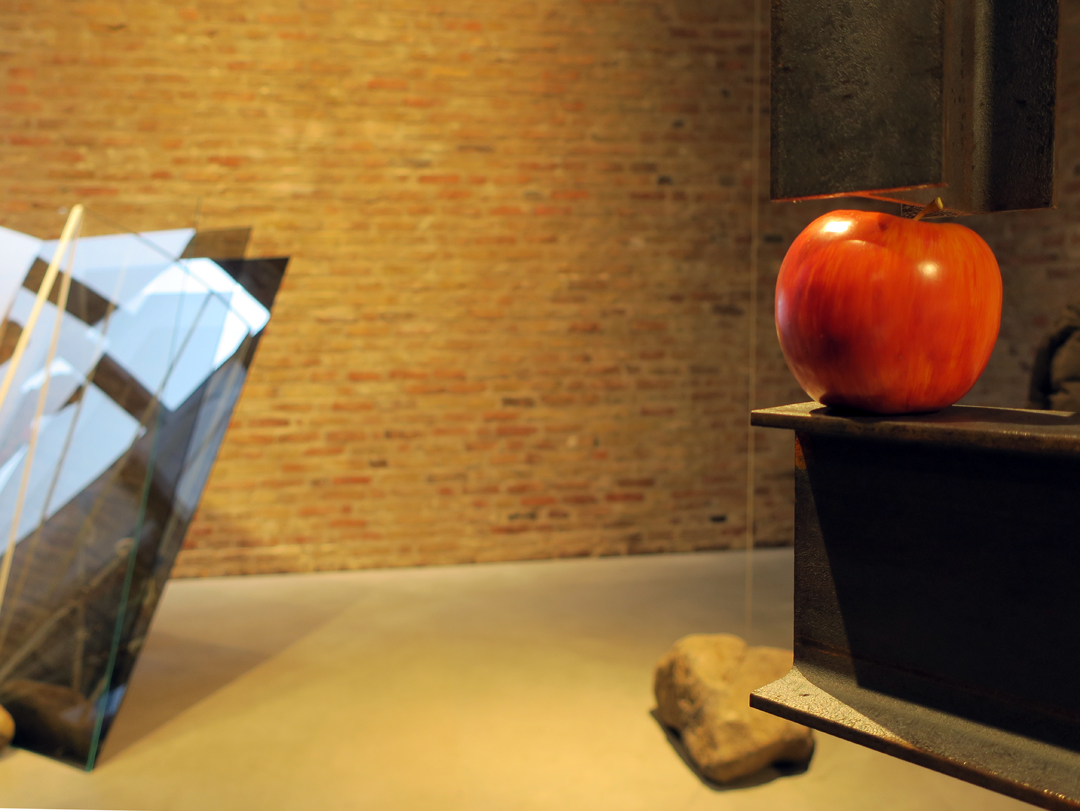
For his second solo exhibition NEWTON’S FAULT at KÖNIG GALERIE in Berlin, Dávila has created a site-specific installation titled that reacts directly to the space.This strategy has recently been used by the artist as away of incorporating the particularities of a space into the dynamics of sculpture.
Two stones in its raw form stabilize the game of weights between the beams.Volcanoes, geothermal energy and the movement of tectonic plates are the primeval sculptors of the rock that anchors Dávila’s sculpture – while the beams that support it are a man-made creation. The dichotomy is also visible in the platonic precise forms of the beams contrasting the organic natural form at the top.
The apple is symbolically placed into the sculptural installation - it has a physical meaning in the sense of Newton’s law of gravitation, while simultaneously utilizing a mythological and religious vocabulary.
The linked sequence of actions and reactions is temporally paused when all the forces are in complete balance. As in his Joint Effort works,the fragments and materials of the sculpture seem to work together as a conscious exertion for a specific common purpose.
The artist emphasizes diametrically opposed qualities of materials. While conveying together Dávila’s interests in architecture, minimalism and the history of art, the sculptures in this project capture a moment of suspension and an ominous tranquility, suitable to the politics of balance.The apparent stillness of the sculptures is the result of the correspondence between forces, the support and the natural tendency of things to fall to earth.
Jose Dávila was born in Guadalajara, Mexico in 1974. He studied architecture in the Instituto Tecnológico y de Estudios Superiores de Occidente in Guadalajara, Mexico, however, he considers himself a self-taught artist,with an intuitive formation.
His work is part of the Getty’s PST LA/LA triennial in Los Angeles and has been exhibited in Hamburger Kunsthalle, Hamburg, DE; Marfa Contemporary, Marfa, USA, Savannah College of Art and Design; Gemeentemuseum, Den Haag; Museum Voorlinden, AG Wassenaar, Nederland, Museo Universitario de Arte Contemporáneo MUAC, Mexico City; Caixa Forum, Madrid; MoMA PS1, New York; Kunstwerke, Berlin; San Diego Museum of Art; Museo de Arte Reina Sofia,Madrid; MAK, Vienna, Fundación/ Colección JUMEX, Mexico City; Bass Museum of Art, Miami; Museu do Arte Moderna, Sao Paulo; The Moore Space, Miami; NICC,Antwerp, among others; and has been featured in international publications such as Cream 3, ed. Phaidon, 100 Latin-American Artists, ed. Exit and The Feather and The Elephant, ed. Hatje Cantz. Jose Dávila has been awarded with the Baltic Artists’Award in 2017.
 
Corinne Wasmuht
KÖNIG GALERIE | NAVE | 20.1.–25.2.2018
 
Corinne Wasmuht
Corinne Wasmuht
Corinne Wasmuht (detail)
Corinne Wasmuht
Corinne Wasmuht
Corinne Wasmuht
Corinne Wasmuht (detail)
Corinne Wasmuht

Press Release: KÖNIG GALERIE is pleased to present new works by Corinne Wasmuht in the main hall of the gallery (St. Agnes I Nave). Conceived especially for the exhibition, the architecture refers to a space of transit, which is a main topic within the artist’s ouevre. Here, a total of six works are on show, all of which were finished during the last year.

Corinne Wasmuht’s complex, multifaceted pictorial worlds develop through a gradual, painstaking process of painting which in a certain sense already begins with her sitting at the computer. Wasmuht selects single motifs and elements from a large collection of photographs that she has taken and combines them in different ways until she finds the basis for her new motif. Once the artist has actually started to paint and has transferred the elements onto the wooden or aluminium surface one by one, the image is freed from its digital template and continues to develop through the dynamic nature of its origin.

Despite their complexity and overwhelming, puzzle-like juxtaposition and superposition of different, often very small forms, the works radiate a deep sense of calm, acting as silent invitations to contemplation. They feature urban, often futuristic scenes reminiscent of airport terminals,pedestrian zones and museum halls, yet they are fragmented and overlapping,they appear both sparse and dense. Architectural structures collide with schematic representations of vegetation and human figures, large monochrome planes are superimposed with detailed, crystalline structures that cover large sections of the image like abstract gaps that nevertheless take up space, recalling digital aesthetics.

In addition to fragmentation and restructuring, repetition is another important element in Corinne Wasmuht’s artistic strategy. Single motifs sometimes resurface in a number of works, often several years apart. The work entitled U1 on show in the exhibition, for instance, features an exact excerpt from Uqbar 1 from 2011. By focusing on a specific section of the image, the artist develops a new narrative in the current piece that mines the structure and dynamic nature of the differently rendered details.

The structuring use of spatial perspective and alignment have a strong impact on the compositions, inexorably sucking the viewer into the image.The images seem readable, as well as pixellated, and the human brain immediately tries to translate the dense yet also clearly delineated forms into a real spatial situation or to identify what is being portrayed. The impossibility of understanding what is happening in the image at first glance further intensifies the process of contemplating it. Like a large panoramic painting, Wasmuht’s works open up an inexhaustible cosmos of different pictorial elements that relate to one another, but that also dominate the pictorial space in and of themselves.

Born in 1964 in Dortmund, Corinne Wasmuht lives and works in Berlin and Karlsruhe. She studied painting at the Kunstakademie Düsseldorf. She has been a professor at the Staatliche Akademie der bildenden Künste, Karlsruhe since 2006. Her work has been awarded numerous prizes and can be seen in solo and group shows, for example at the Venice Biennial, Venice, Italy; Albright-Knox-Museum, Los Angeles, USA; Städel Museum, Frankfurt/Main,Germany; Kunstmuseum Stuttgart, Germany; and Kunsthalle zu Kiel, Germany.