Jose Dávila
KÖNIG GALERIE | CHAPEL
|
20.1.–25.2.2018
 |
| Jose Dávila |
 |
| Jose Dávila |
 |
| Jose Dávila |
 |
| Jose Dávila |
 |
| Jose Dávila |
 |
| Jose Dávila |
For
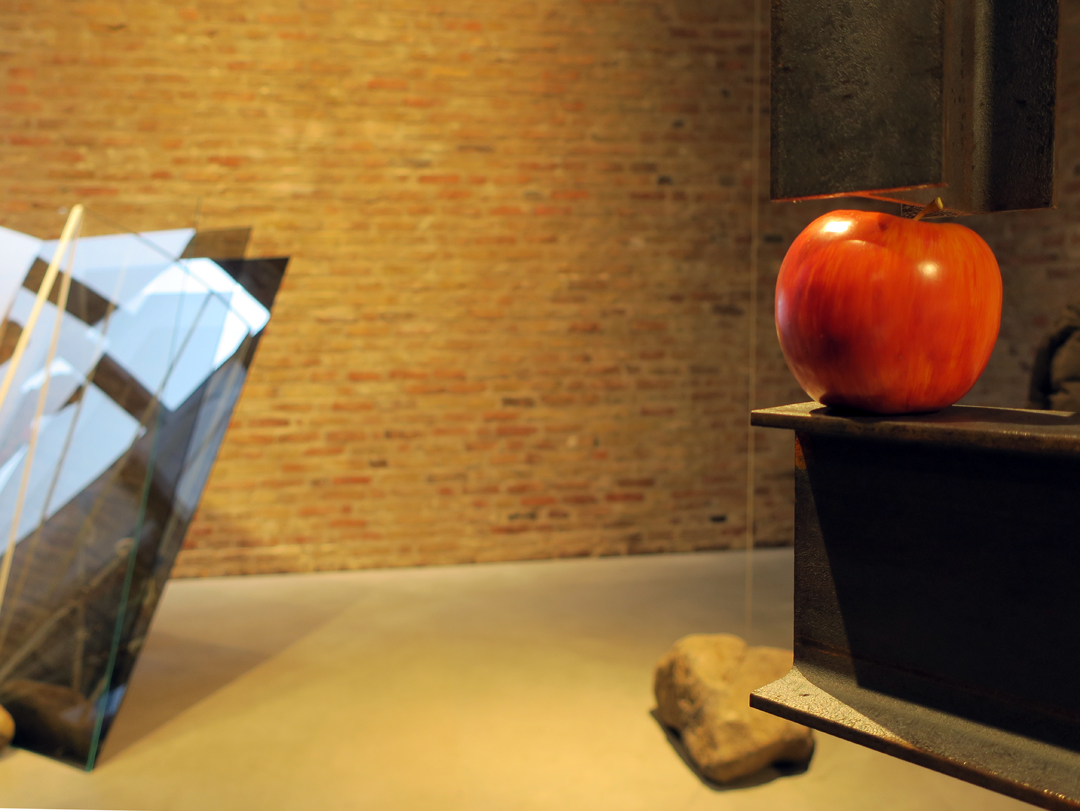
his second solo exhibition NEWTON’S FAULT at KÖNIG GALERIE in Berlin,
Dávila has created a site-specific installation titled that reacts
directly to the space.This strategy has recently been used by the artist
as away of incorporating the particularities of a space into the
dynamics of sculpture.
Two stones in its raw
form stabilize the game of weights between the beams.Volcanoes,
geothermal energy and the movement of tectonic plates are the primeval
sculptors of the rock that anchors Dávila’s sculpture – while the beams
that support it are a man-made creation. The dichotomy is also visible
in the platonic precise forms of the beams contrasting the organic
natural form at the top.
The apple is
symbolically placed into the sculptural installation - it has a physical
meaning in the sense of Newton’s law of gravitation, while
simultaneously utilizing a mythological and religious vocabulary.
The
linked sequence of actions and reactions is temporally paused when all
the forces are in complete balance. As in his Joint Effort works,the
fragments and materials of the sculpture seem to work together as a
conscious exertion for a specific common purpose.
The
artist emphasizes diametrically opposed qualities of materials. While
conveying together Dávila’s interests in architecture, minimalism and
the history of art, the sculptures in this project capture a moment of
suspension and an ominous tranquility, suitable to the politics of
balance.The apparent stillness of the sculptures is the result of the
correspondence between forces, the support and the natural tendency of
things to fall to earth.
Jose Dávila was born
in Guadalajara, Mexico in 1974. He studied architecture in the Instituto
Tecnológico y de Estudios Superiores de Occidente in Guadalajara,
Mexico, however, he considers himself a self-taught artist,with an
intuitive formation.
His work is part of the
Getty’s PST LA/LA triennial in Los Angeles and has been exhibited in
Hamburger Kunsthalle, Hamburg, DE; Marfa Contemporary, Marfa, USA,
Savannah College of Art and Design; Gemeentemuseum, Den Haag; Museum
Voorlinden, AG Wassenaar, Nederland, Museo Universitario de Arte
Contemporáneo MUAC, Mexico City; Caixa Forum, Madrid; MoMA PS1, New
York; Kunstwerke, Berlin; San Diego Museum of Art; Museo de Arte Reina
Sofia,Madrid; MAK, Vienna, Fundación/ Colección JUMEX, Mexico City; Bass
Museum of Art, Miami; Museu do Arte Moderna, Sao Paulo; The Moore
Space, Miami; NICC,Antwerp, among others; and has been featured in
international publications such as Cream 3, ed. Phaidon, 100
Latin-American Artists, ed. Exit and The Feather and The Elephant, ed.
Hatje Cantz. Jose Dávila has been awarded with the Baltic Artists’Award
in 2017.
Corinne Wasmuht
KÖNIG GALERIE | NAVE
|
20.1.–25.2.2018
 |
| Corinne Wasmuht |
 |
| Corinne Wasmuht |
 |
| Corinne Wasmuht (detail) |
 |
| Corinne Wasmuht |
 |
| Corinne Wasmuht |
 |
| Corinne Wasmuht |
 |
| Corinne Wasmuht (detail) |
 |
| Corinne Wasmuht |
Press Release: KÖNIG GALERIE is pleased to present new works by Corinne Wasmuht in
the main hall of the gallery (St. Agnes I Nave). Conceived especially
for the exhibition, the architecture refers to a space of transit, which
is a main topic within the artist’s ouevre. Here, a total of six works
are on show, all of which were finished during the last year.
Corinne
Wasmuht’s complex, multifaceted pictorial worlds develop through a
gradual, painstaking process of painting which in a certain sense
already begins with her sitting at the computer. Wasmuht selects single
motifs and elements from a large collection of photographs that she has
taken and combines them in different ways until she finds the basis for
her new motif. Once the artist has actually started to paint and has
transferred the elements onto the wooden or aluminium surface one by
one, the image is freed from its digital template and continues to
develop through the dynamic nature of its origin.
Despite
their complexity and overwhelming, puzzle-like juxtaposition and
superposition of different, often very small forms, the works radiate a
deep sense of calm, acting as silent invitations to contemplation. They
feature urban, often futuristic scenes reminiscent of airport
terminals,pedestrian zones and museum halls, yet they are fragmented and
overlapping,they appear both sparse and dense. Architectural structures
collide with schematic representations of vegetation and human figures,
large monochrome planes are superimposed with detailed, crystalline
structures that cover large sections of the image like abstract gaps
that nevertheless take up space, recalling digital aesthetics.
In
addition to fragmentation and restructuring, repetition is another
important element in Corinne Wasmuht’s artistic strategy. Single motifs
sometimes resurface in a number of works, often several years apart. The
work entitled U1 on show in the exhibition, for instance, features an
exact excerpt from Uqbar 1 from 2011. By focusing on a specific section
of the image, the artist develops a new narrative in the current piece
that mines the structure and dynamic nature of the differently rendered
details.
The structuring use of spatial
perspective and alignment have a strong impact on the compositions,
inexorably sucking the viewer into the image.The images seem readable,
as well as pixellated, and the human brain immediately tries to
translate the dense yet also clearly delineated forms into a real
spatial situation or to identify what is being portrayed. The
impossibility of understanding what is happening in the image at first
glance further intensifies the process of contemplating it. Like a large
panoramic painting, Wasmuht’s works open up an inexhaustible cosmos of
different pictorial elements that relate to one another, but that also
dominate the pictorial space in and of themselves.
Born
in 1964 in Dortmund, Corinne Wasmuht lives and works in Berlin and
Karlsruhe. She studied painting at the Kunstakademie Düsseldorf. She has
been a professor at the Staatliche Akademie der bildenden Künste,
Karlsruhe since 2006. Her work has been awarded numerous prizes and can
be seen in solo and group shows, for example at the Venice Biennial,
Venice, Italy; Albright-Knox-Museum, Los Angeles, USA; Städel Museum,
Frankfurt/Main,Germany; Kunstmuseum Stuttgart, Germany; and Kunsthalle
zu Kiel, Germany.


